

Before we compare capacity, price, or drive type, we recommend answering a simpler question: can the truck physically enter and support the pallets your operation actually uses? A pallet can be described as “standard” and still differ in opening height, opening width, bottom boards, stringers, or the direction from which it can be entered. Those details can decide whether a proposed pallet truck is practical.
This is a fit-check guide, not a universal compatibility claim. At KAIXUN, we ask buyers to measure their real pallets and request model-specific confirmation before an order is finalized.
1. Measure the pallet opening, not only the outside size
Record the pallet’s outside length and width, then measure the clear opening where each fork must pass. The useful measurements are the opening’s clear height, clear width, and usable depth from the entry edge to the internal support or obstruction. Photograph the entry side and the underside as well.
Do not infer the opening from the pallet label. Toyota Material Handling’s pallet guide explains that pallet construction and terminology vary by country and describes open, bottom-boarded, stringer, and bearer designs. Its stringer-pallet guidance also distinguishes the side from which a low-fork hand pallet truck should pick up the pallet. That is why a buyer should document both the pallet style and the intended entry direction.
2. Check the truck’s lowest fork height against the real entry
Fork lowest height is not the same thing as a promise that every pallet will accept the truck. Compare the supplier’s stated lowest fork height with the clear vertical opening at the entry point, while considering the pallet’s condition, floor surface, and any bottom board that narrows the path. Leave the supplier to confirm the fit for the exact pallet construction rather than treating a rounded measurement as approval.
For example, the KAIXUN KX-SDC30 product page lists a 3.3-inch fork lowest height, a 7.9-inch maximum fork height, 48-inch fork length, and a 2.1-by-6.3-inch fork size. Those are the published fields for that model; they do not establish that it will enter an unmeasured pallet or a different pallet design.
3. Check fork width, spacing, and the path around supports
Measure the clear distance between the pallet’s internal supports and note any blocks, side bearers, bottom boards, nails, broken boards, or wrap that could obstruct the forks. Then compare those observations with the proposed truck’s fork width, fork spacing, and overall width. A pallet may accept one fork arrangement from one side but not another.
Ask for a dimensioned drawing or the exact specification sheet, not only a product title such as “27-inch forks.” Clarify what the stated width represents, which dimensions are measured at the fork, and whether the quoted configuration differs from an option shown in a photograph. If your pallets vary, send the supplier measurements and underside photographs for each important type.
4. Confirm fork length and usable support
Forks need enough usable length to support the load in the way the equipment instructions require, but longer is not automatically better. The fork path must stop before it contacts a closely stacked pallet, rack component, or another obstruction. OSHA’s load-handling guidance says to level the forks before insertion, place them under the load as far as possible, and be careful that they do not pass through to the other side where pallets are closely stacked. For powered industrial trucks, OSHA’s 1910.178 standard likewise requires the load-engaging means to be placed under the load as far as possible and limits handling to loads within the truck’s rated capacity.
Use those sources as operating guidance, not as a substitute for the selected model’s manual or your site’s safety procedures. Ask the supplier to identify the applicable operating manual and any model-specific limits before approval.
5. Check the pallet’s construction and condition
Two pallets with the same outside dimensions can present different fork-entry conditions. Record whether each pallet is open-entry, stringer-based, bearer-based, or bottom-boarded; whether entry is two-way or four-way; and whether the underside has damaged, missing, or loose boards. Note overhang, uneven loads, and any deck boards that flex or block a fork path.
We also recommend a small receiving test using a representative pallet, but only under your site’s approved procedure and with the equipment documentation followed. A test should confirm controlled entry and full support without forcing the forks, striking the pallet, or relying on an improvised load. It should not be treated as evidence that every pallet in the fleet is compatible.
6. Send a fit packet with the purchase request
For a buyer, distributor, or procurement team, the fastest way to reduce ambiguity is to send one concise fit packet:
- Photos of the pallet from the entry side and underside.
- Outside pallet dimensions and clear opening height, width, and depth.
- Pallet construction, entry direction, and any bottom boards or internal supports.
- Loaded weight range, load overhang, and whether the load is centered or irregular.
- Floor, threshold, dock, rack, or stacking conditions that affect the approach.
- The exact product SKU or configuration being quoted, plus the requested dimension drawing and manual.
Ask the supplier to answer in writing: “Will this exact configuration enter this pallet from the stated side?” Request the assumptions, the dimension used for the comparison, and any exceptions. If the supplier cannot confirm a model-level fit, keep the question open rather than converting a product-category description into a compatibility promise.
7. Use product pages as starting points, not the final fit decision
Our pallet jack collection lets buyers compare published product fields across manual, electric, and scale pallet jacks. As another example, the KAIXUN KX-PPT15A product page lists a 3.3-inch fork lowest height, 7.6-inch maximum fork height, and 45-by-6-by-2-inch fork size. Those fields help you organize a comparison; they are not a universal approval for every pallet.
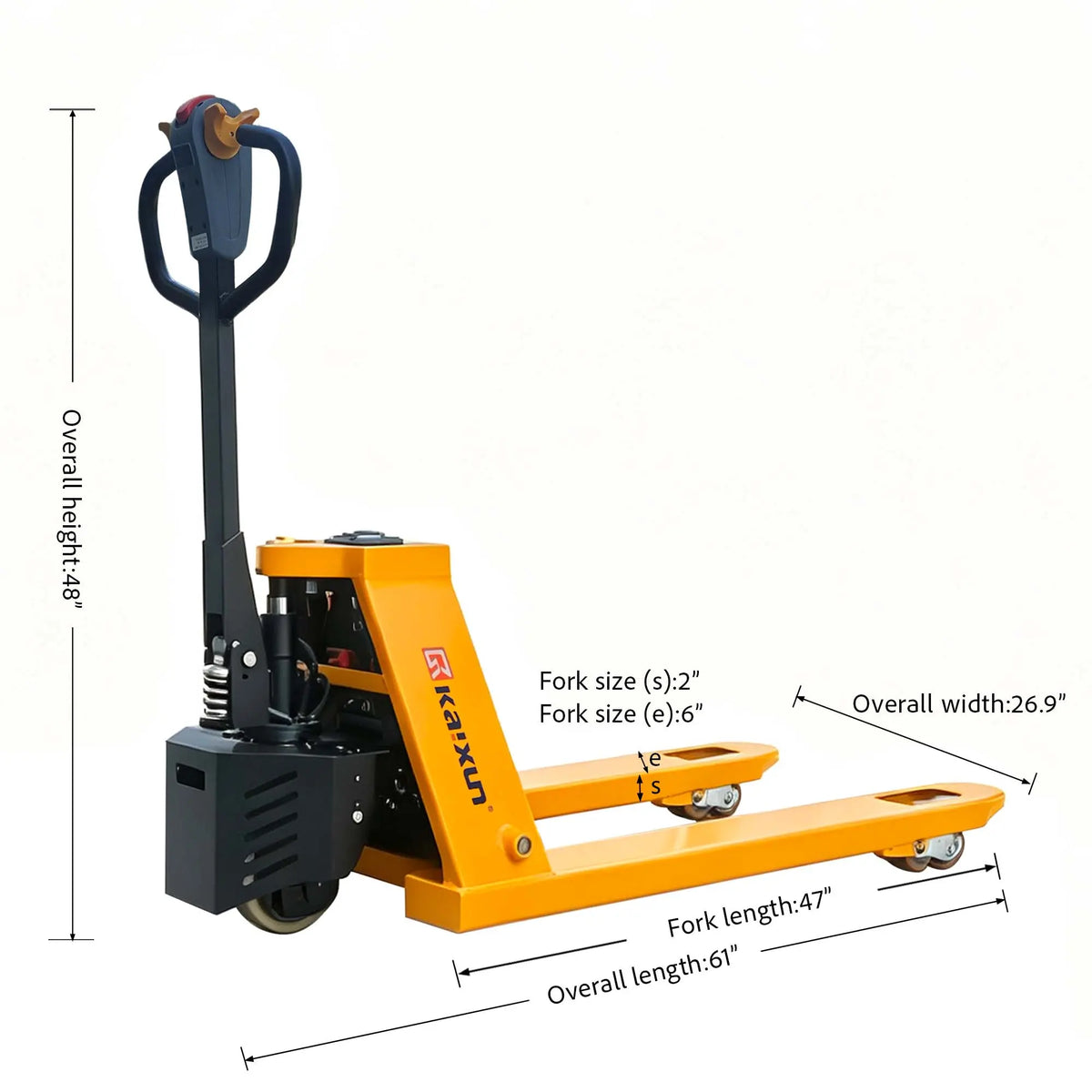
When the fit packet is complete, contact KAIXUN through our contact page with the exact model, pallet measurements, photographs, and open questions. That gives our team a factual basis for responding and gives your purchasing record a clear trail for later review.
Final pre-order check
Before approving the truck, make sure your file contains the measured pallet openings, entry direction, fork-path notes, exact model dimensions, the supplier’s written assumptions, and any unresolved exceptions. A capacity number or “standard pallet” label cannot replace that comparison. We recommend treating pallet-entry fit as a documented purchasing decision, not a guess made after delivery.